The Weekly Homeschool Planner
On this page, I will discuss the pros and cons of the homeschool weekly planner and I will list recommended forms for the weekly planner.
What is a Weekly Lesson Planner
A Weekly Planner the most commonly used planner and with it, lesson plans for each week and for all subjects are laid out together on one or more pages. Lesson plans are usually listed in a daily format, but, depending on the form style, lessons plans can be listed in a weekly or a chapter format. Donna, what are you talking about? Read my examples of the lesson planning formats below.
The Lesson Planning Formats, one example of each format
The words in parenthesis are implied and do not necessarily need to be written on the planner.
Daily format: (Today) Read pages____ and do this...
Weekly format: (This week) Complete the following... Be prepared to discuss at class meeting on __date__ .
Chapter format: Read
chapter # and complete ... . Assignments are due on __date__ by the end of class.
Topics on This Page
- Weekly Homeschool Planner: Pros and Cons and the Solutions to the Drawback
- Donna's Recommended Homeschool Forms Listed in Page Order
- How to Use a Homeschool Weekly Planner without much Frustration
Pros and Cons of Using a Weekly Lesson Planner
The Appealing Pro
All of the lessons plans for all of the subjects are laid out on the same page or two. As many of you know, having all of the lessons plans on display like this is incredibly convenient.
The Mother of Cons
 When a planned lesson is not completed on the day that it is written in the planner, then it must be completed the next day, which might already have a lesson plan slotted. The resulting overlapping lesson plans can affect the rest of the planner pages that are filled in with lesson plans. If you plan two weeks or more ahead of time, then you will end up with a big sloppy mess. I know.
Bring on the liquid paper! I covered up and re-slotted lesson plans countless times during the school year because I tended to plan six weeks or more in advance during my early homeschooling years. I preferred to plan in advance and that is probably what led me toward making subject planners so that I could make lesson plans for the entire school year.
Solutions to the Missed Lesson and Suggestions
Having one major drawback is not necessarily a deal-breaker. If you write up to three weeks of lesson plans into your weekly planner then you might not experience this drawback to an intolerable degree; however, if you plan a month or more in advance, keep reading.
Solution 1, Planning on Subject Planners
If you write lesson plans for several weeks or as far ahead as the entire year, write all of your lesson plans into subject planners and keep the subject planners in your homeschool planner. Each week transfer lesson plans from the subject planner to the weekly planner. See: Transfer Plans from Subject Form to Weekly Form for an illustration of transferring plans and for more information on the topic.
Solution 2, Planning on Weekly Planners for up to Two Weeks
While I do not recommend planning on the fly, you can do that if you are comfortable with living on the edge. Or, more realistically, write lesson plans in your planner for only one week, or two weeks at most. Of course, this requires diligence on your part, so make sure to decide when you will write these lesson plans each week. If the weekend is the only free time you have for planning, then I recommend Solution 1 and plan ahead for at least six weeks using a subject planner form. Why, you might wonder? It is my opinion that you will need most of your weekends off.
Solution 3, Daily Planner
Use a daily planner. I have never used a daily planner but I know some very organized homeschoolers who do. From my limited conversations with them, I gather that they tend to love planning, they plan each subject separately for the entire year, and then refine the lesson plans on a daily basis with a daily planner form.
Electronic Solution
Use Donna Young's V Planner, a spreadsheet file that requires Microsoft Excel. V Planner allows you to plan ahead as far as you need and then it allows you to send any lesson plan to its various planners. Lesson plans can also be placed automatically by date and imported to Google Calendar. V Planner is available via a subscription to YoungMinds.
Planner Forms for the Weekly Homeschool Planner
Below I have linked the forms I usually used and placed in my weekly planner in the following order:
- Title Page is optional.
- Calendar
- Events Calendar is optional but useful.
- Attendance Calendar is optional but essential for some.
- Course of Study
- Goals
- Book List Forms
- Curriculum Key is essential for weekly planner.
- Six weeks of weekly planner forms
- Objectives forms are optional but I found these necessary to keep on top of my children's trouble spots when they were younger.
- Repeat items 9 and 10 until you have enough weeks. The typical school year is 36 weeks, your year may be longer.
- Subject Planners, I consider these essential forms, more about that in How to Use.
- Grades Forms are optional but essential for some.
- A few Journal Forms are optional unless you like to make notes.
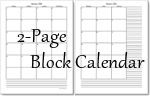
- Any household forms that you want to include, after all, if household chores are in the planner, that increases the possibility that chores will get done. If it helps, print one of my big notebook block calendars that has either one page per month or two pages per month and pencil in appointments, chores, and important dates. Also consider making yourself sit down and write a month's worth of lunch menus. Reuse the menu throughout the year.
See also Essential Homeschool Forms
How to Use a Homeschool Weekly Planner without much Frustration
Please keep the following tips in mind when you use your weekly planner:
- Make lesson plans on subject planners (term planners) first and be sure to place the subject planners in your planner.
- Fill in the weekly planner either a week or two in advance, or the day before, or on the very day your children do the work. The plans come from your completed subject planners! This way, you will waste less money on white-out. You will also have the opportunity to refine the lesson plans.
- Be diligent and mark work completed. If there is a grade, add the grade to the lesson plan block or to your grade planner on the very day it is done. Please don't spend your weekends grading papers! An exception to this would be grading complex work such as a research paper. If that is the case, make use of my XLS Composition Grader if you have a spreadsheet program.
Related at DonnaYoung.org
Donna's Definitions: Subject Planner and Weekly Planner
Key differences are underlined.
Note: Despite the representational images, planner styles vary at donnayoung.org.
Subject Planner
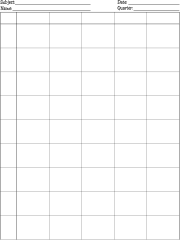
The subject planner form (aka term, quarter, semester) is meant to have lesson plans for one subject. Generally the squares on the subject planner are not date specific. In other words, the 5th column does not necessarily indicate Friday.
Weekly Planner
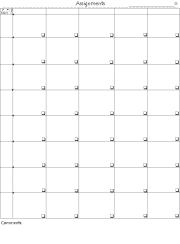
The weekly planner form is meant to have lesson plans for all subjects. Generally the squares on the subject planner are date specific, in other words, the 5th column usually indicates Friday.
Updated 7/11/2015
Donna Young
Hello Visitor!
I am currently working on this website to add to its ginormousness. Thank you for visiting, and please subscribe yearly to access my many printable files! Donna Young
May 13, 2021


 Printable Files and Quiz
 High School Diploma

 RSS Feed